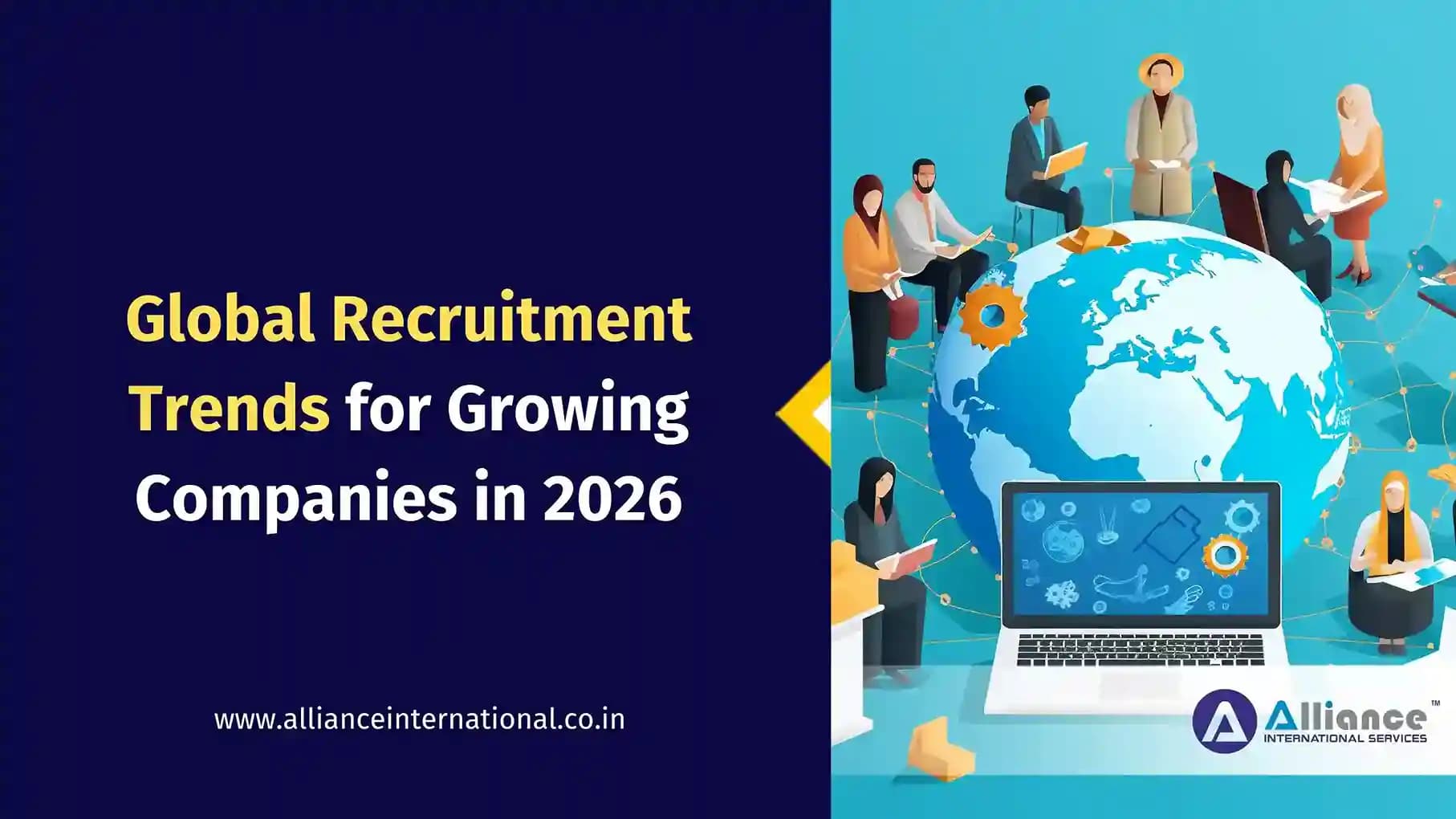
Global Recruitment Trends for Growing Companies in 2026
Share this topic on



Explore this post with:
Table of Contents
Recruitment in 2026 looks almost nothing like it did five years ago. The old playbook- post a job, collect resumes, interview, hire has been replaced by something far more strategic. Companies today aren't just filling seats; they're building talent ecosystems designed to support long-term growth.
This shift from volume hiring to strategic hiring is the single biggest change shaping the recruitment landscape. Businesses are no longer measuring recruitment success by how fast a role gets filled. They're measuring it by retention, skill fit, cultural alignment, and how well a hire contributes to business outcomes months and years down the line.
For growing companies, especially those expanding across borders or scaling rapidly, understanding global recruitment trends isn't optional anymore. It's the difference between building a workforce that fuels growth and one that holds it back.
Working with an experienced International Recruitment Services partner has become essential for companies trying to navigate this complexity while staying focused on their core business.
Why Global Recruitment Is Becoming a Business Growth Strategy
Three forces are pushing recruitment from an HR function to a core growth strategy:
Talent shortages: Many industries- technology, healthcare, engineering, finance don't have enough qualified local talent to meet demand. Companies that limit their search to one country are competing for a shrinking pool.
Expansion into new markets: As companies enter new regions, they need local leadership and teams who understand the market, language, and regulatory environment from day one.
Access to specialized skills: Certain skill sets AI engineering, cybersecurity, advanced data science are concentrated in specific talent hubs globally. Businesses that recruit only domestically miss out on this specialized expertise entirely.
Together, these forces mean that global hiring trends are no longer a "nice to have" for multinational giants; they're becoming standard practice for mid-sized and growing businesses too.
Trend 1: Skills-First Hiring Is Replacing Degree-First Hiring
Companies are increasingly evaluating candidates based on demonstrated skills rather than academic credentials alone. A candidate who can prove capability through a portfolio, assessment, or practical test is often a stronger hire than one who holds the "right" degree.
This shift toward skills-based hiring widens the talent pool significantly; it opens doors for career-changers, self-taught professionals, and candidates from non-traditional educational backgrounds who may be a better functional fit for the role.
Trend 2: AI Is Transforming Recruitment Without Replacing Recruiters
Artificial intelligence has become deeply embedded in the recruitment process, but not in the way many people feared. Rather than replacing human recruiters, AI recruitment tools are handling the repetitive, time-consuming parts of the job so recruiters can focus on judgment-based decisions.
Here's where AI is making the biggest impact:
- AI sourcing: Scanning millions of profiles across platforms to identify candidates matching specific criteria in minutes rather than days.
- Resume screening: Automatically filtering applications based on skills, experience, and role requirements.
- Candidate matching: Using pattern recognition to surface candidates who are a strong fit even if their resume doesn't use exact keyword matches.
- Human oversight: Recruiters still make the final call on cultural fit, communication style, and leadership potential- things algorithms can't fully assess.
AI adoption continues to rise across the industry, but the organizations getting the best results are the ones using it to augment their recruiters, not replace them.
Trend 3: Companies Are Hiring Talent Beyond Borders
Cross-border hiring has moved from a niche practice to a mainstream strategy. Remote work infrastructure, matured over the past several years, has made it entirely practical for companies to hire the best person for a role regardless of where they're physically located.
This has fueled major growth in International Recruitment as businesses look for partners who understand local labor laws, compensation benchmarks, and cultural nuances across multiple countries, something that's nearly impossible to manage well without dedicated expertise.
Industries leading this shift include technology, customer support, finance, and professional services all sectors where output quality matters more than physical location.
Trend 4: Employer Branding Has Become a Competitive Advantage
In a market where top talent has options, employer branding has become just as important as the job offer itself. Candidates research company culture, employee reviews, and leadership reputation before they even apply.
Companies investing in authentic employer branding, showcasing real employee stories, transparent career paths, and genuine values, are winning talent away from competitors who rely purely on salary as their pitch. Strong employer branding also improves candidate experience, creating a compounding advantage: a better brand attracts better candidates, who then become brand advocates themselves.
Trend 5: Executive Hiring Is Becoming More Strategic
Leadership hiring in 2026 is far more rigorous than it used to be. Boards and investors are demanding leaders who can navigate ambiguity, drive digital transformation, and execute under pressure not just leaders with an impressive resume.
This is why more companies are turning to specialized Executive Search Consultants who bring structured assessment methodologies and deep networks that internal teams typically can't match for senior leadership roles.
Trend 6: Recruitment Process Outsourcing (RPO) Continues to Grow
As hiring volumes fluctuate and talent markets grow more competitive, more companies are turning to recruitment outsourcing to manage all or part of their hiring function. RPO providers bring dedicated recruitment infrastructure, technology, and expertise without the overhead of building an in-house team from scratch.
RPO Services allow growing companies to scale hiring up or down quickly based on business needs without the fixed cost burden of a large internal talent acquisition department.
Trend 7: Data-Driven Recruitment Is Improving Hiring Decisions
Hiring analytics are now central to how leading companies make recruitment decisions. Instead of relying on gut instinct, talent teams are tracking metrics like time-to-fill, cost-per-hire, source of hire quality, and post-hire performance to continuously refine their process.
This data-driven approach also feeds into better workforce management, helping leadership understand where hiring bottlenecks exist and which recruitment channels actually deliver quality candidates, not just volume.
Trend 8: Candidate Experience Influences Hiring Success
A slow, confusing, or impersonal hiring process drives away strong candidates before they even get an offer. In competitive markets, candidates are comparing not just compensation but how they were treated throughout the process. Communication speed, interview clarity, and feedback quality all matter.
Companies that prioritize a smooth, respectful hiring journey are seeing higher offer-acceptance rates and stronger employer reputations in return, proof that candidate experience isn't a "soft" metric; it directly affects hiring outcomes.
Trend 9: Workforce Planning Is Replacing Reactive Hiring
Reactive hiring scrambling to fill a role only after someone quits or a project suddenly needs staffing is being replaced by proactive workforce planning. Growing companies are now mapping out anticipated hiring needs 6–12 months in advance, aligned with business growth projections.
This shift allows businesses to build talent pipelines ahead of need, rather than starting the search from zero every time a vacancy opens, significantly reducing time-to-hire for critical roles.
Trend 10: Recruitment Agencies Are Becoming Strategic Business Partners
Recruitment agencies today do far more than fill open positions. The best agencies function as extensions of a company's leadership team, offering market intelligence, compensation benchmarking, competitor talent insights, and long-term workforce strategy advice.
This evolution reflects a broader trend: businesses no longer view recruitment as a transactional service, but as a strategic partnership that directly influences their ability to grow and compete.
How Growing Companies Can Prepare for Future Recruitment Trends
A practical checklist for staying ahead:
- Audit your current hiring process: Identify where delays, drop-offs, or poor-quality hires are happening.
- Invest in employer branding: Make sure your company's story is visible to passive candidates, not just active job seekers
- Adopt AI tools thoughtfully: Use automation for sourcing and screening, but keep human judgment in final decisions
- Build a workforce plan: Map hiring needs against business growth projections, not just current vacancies
- Consider RPO or a recruitment partner: Especially if you're scaling fast or entering new markets without local expertise
- Track hiring data: Measure what's working so you can double down on effective channels
Conclusion
The recruitment landscape of 2026 rewards companies that think strategically: those blending AI efficiency with human judgment, skills-first hiring with strong employer branding, and reactive hiring with proactive workforce planning.
Growing companies that build resilient, forward-looking hiring strategies today will have a clear advantage over competitors still relying on outdated, reactive recruitment methods. The right Recruitment Services partner can help you navigate all ten of these trends without stretching your internal team thin.
Whether you're expanding into new markets, hiring executive leadership, or simply trying to keep pace with talent demand, partnering with a Global Manpower Services provider gives your business the reach and expertise to hire smarter in 2026 and beyond.
FAQs
Ans. They're the evolving hiring practices like AI adoption, skills-first hiring, and cross-border recruitment shaping how companies attract talent worldwide.
Ans. To access specialized skills, address local talent shortages, and support expansion into new markets more effectively.
Ans. AI speeds up sourcing, screening, and candidate matching, while recruiters still handle judgment-based decisions like cultural fit.
Ans.
It's an approach that evaluates candidates on demonstrated abilities rather than relying solely on academic degrees.
Ans.
RPO lets companies scale hiring flexibly without the fixed cost of building a large in-house recruitment team.
Ans. Technology, finance, healthcare, and professional services are leading in cross-border and remote hiring right now.
Ans.
It shifts hiring from reactive to proactive, letting businesses build talent pipelines ahead of actual need.
Ans. Alliance International connects businesses with skilled talent across 36+ countries, combining local market expertise with global reach.